The Method Men
Thomas Levy, Elliot Purse, and Zhang Kaitong
TheBlanc
15 East 40th Street, New York
Nov. 16, 2024 - Feb. 5, 2025
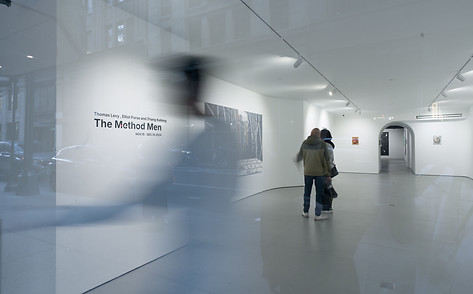
Art invents its own problems, while life just throws them at you, unsolicited. A blank canvas demands solutions—form, color, line, composition—and so does life, though in its own brutal, unexpected ways. Could painting, in its careful constructions, help resolve the disorder of living? The hypothesis is that, by tackling these problems on canvas, the artist can try to resolve larger issues in life. Can the act of balancing shape and shade truly lead to a kind of inner equilibrium? The theory is put to the test in the works of these three artists, as they navigate loss, manage fear, and confront the complexity and fragility of the self.
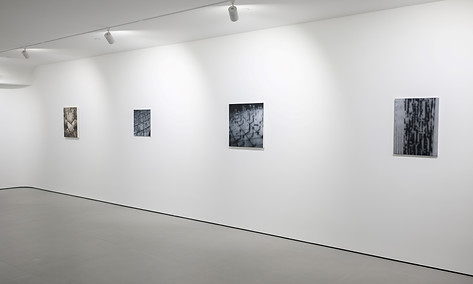
After almost a decade in New York, Thomas Levy (b. 1987) returned to his home country England earlier this year. His recent work delves into a place where presence and absence blur. After the loss of his long-term partner to cancer, he seems to have been fascinated by things that go on infinitely—stairs, textiles, grids, patterns, cosmos—forms that expand endlessly across his canvases. Some of the sources of these images are deeply personal, while others are influenced by his research on consciousness and his daily practice of meditation.

Thomas Levy, Eternal Nothingness for My Love, 2023. Oil on canvas.
When he is not painting expressively, his method leans towards a kind of abstracted photorealism. A pervasive sense of melancholy marks much of his work, albeit rendered with a cool, cerebral reserve. The limited, almost monochromatic color palette creates an effect of hazy softness that speaks volumes through its restraint.

Thomas Levy, Kew, 2024. Oil on canvas.
When he is not painting expressively, his method leans towards a kind of abstracted photorealism. A pervasive sense of melancholy marks much of his work, albeit rendered with a cool, cerebral reserve. The limited, almost monochromatic color palette creates an effect of hazy softness that speaks volumes through its restraint.
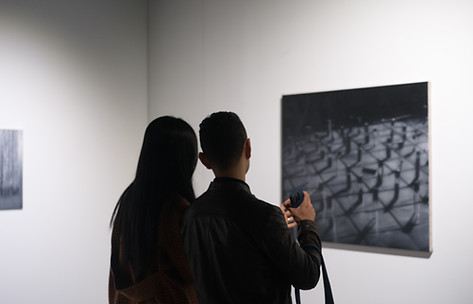
Thomas Levy, Table 2, 2024. Oil on linen.
One senses a deeply felt undercurrent beneath the grisaille-like surface of calm detachment, but is prevented from being swept away by intense emotions. In a sense, one is left with an afterimage of once strong sentiments. Through repetition the artist achieves a kind of erasure—a process perhaps not unlike the way he himself has dealt with life’s upheavals.

Left: Thomas Levy, Adelson's Checkerboard, 2023. Oil on panel. Right: Zhang Kaitong, Untitled, 2022. Mixed media on canvas
Born into a family of artists, Zhang Kaitong (b. 1991) received his formal training in Kassel, Germany, and currently divides his time between Berlin, Athens, and Beijing. The wealth of historical materials found in these places are frequent subjects of appropriation for Zhang. He often uses prints and paintings from the Middle Ages and the Renaissance, selecting images of strong psychological potency—such as depictions of war, destruction, and punishment—as the basis for his painting experiments.

Zhang Kaitong, Untitled, 2022. Acrylic on canvas.
Zhang employs a set of visual strategies intended to drain these once-powerful imageries of their emotional charge. He states that his goal is to “reach a state of zero,” where strong emotions are muted and neutralized.

Having experienced a period of psychological illness, Zhang seeks equilibrium in both art and life. Buddhism informs his painting practice, which sets out to reveal the illusory nature of reality as seen by the eye. His paintings are exercises in control and balance—disciplines he carries into his life outside the studio. Zhang is a vegetarian and refrains from drinking.

Zhang Kaitong, Untitled Emotion, 2023. Mixed media on canvas.
For a long time, Elliot Purse’s (b. 1989) practice examines masculinity, or rather, its brittle construction in the post-Trump American landscape. His approach is not confrontational, but one of delicate subversion.An adept draftsman, Purse portrays soft, organic forms with the texture of hard marble. The toughness and machismo typically associated with some of his usual subjects—boxers, wrestlers, bodybuilders—are undermined by subtle details, as the figures appear defeated and sapped of energy.

Elliot Purse, Fumo, 2024. Oil on canvas over panel.
More recently, seashells and fragmented faces reminiscent of classical sculptures begin to emerge on his canvas. There is a fragile elegance about these subjects, a clash of textures and feel, where brittle seashells are rendered in immaculately smooth marble, and the presumed hardness of stone faces is punctured by the appearance of lip and nose rings.


Elliot Purse, Red Marble Shell, 2024 (left), Green Stone Shell, 2024 (right), Oil on canvas over panel.

Through his technical mastery of the medium, Purse finds a way to convey fragility within solidity, revealing a beauty on the verge of collapse.

Elliot Purse, Artifact, 2024. Oil on canvas over panel.
The Method Men speaks to a relentless engagement with process, focusing on artists who approach their work not with spontaneous bursts of expression but with a rigorous, meticulous devotion to craft. Thomas Levy and Elliot Purse were alumni of the New York Academy of Art, which “quietly fuels the figurative resurgence” according to Artnet. Zhang Kaitong combines the conceptually oriented art education he received at Kunsthochschule Kassel with the formal painting training he had done in China. Their robust backgrounds and technical ability afford them a certain freedom to explore, allowing them to start from a more honest place and to develop their respective styles organically. The belief is that the discipline of painting—of solving the canvas’s demands—is as much a path to self-knowledge as it is to artistic accomplishment.
